
Concertgoers who wanted to buy a ticket for John Mayer in some cases paid up to 400 euros per ticket. So writes Ties van Kesteren in the article published on nos.nl, the website of NOS (the Dutch public broadcaster).
The cause: dynamic pricing, or variable prices.
The concept of dynamic pricing
Everyone has come across the concept of dynamic pricing at some point. For years the airline and hotel industries have matched the price to demand.
In fact, every business that aims to make a profit sets its price based on supply and demand, but with dynamic pricing the price is set at every moment based on the supply and demand at that moment (= real time).
Dynamic pricing done well generates more revenue. This applies mainly to products or services whose supply is relatively hard to change (such as hotels and aircraft).
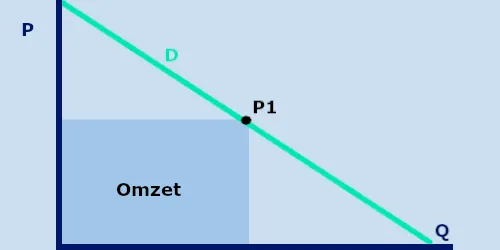
revenue without dynamic prices

higher revenue with dynamic prices
More and more companies apply dynamic pricing
Dynamic pricing has been gaining popularity fast lately. American companies such as Uber and AirBnB apply the concept, but so do more and more Dutch companies.
Not that long ago the ANWB introduced gas and electricity tariffs based on dynamic prices and Albert Heijn digitalised the concept of dynamic markdowns to reduce food waste.
Dynamic pricing: ethically irresponsible?
On a quick reading of the article published by Ties van Kesteren, dynamic pricing seems to be portrayed as an ethically irresponsible tool with which the operators themselves make too much money from a concertgoer. In this case Ticketmaster.
"Music venue Paradiso (itself a non-profit foundation) also does not see dynamic pricing as a good development. "For the artist it is positive, because they earn more money from the same concert. We, however, think it is a less good development", says Erik Luyten, head of ticket sales at Paradiso."
"The Ministry of Education, Culture and Science considers dynamic pricing an unwelcome development, but calls it a matter for the market."
Although I agree that concerts and events (culture) should be accessible to everyone, I think it is too simplistic to paint dynamic pricing as the bogeyman in this story.
The (ethically) positive sides of variable prices
The article only highlights one aspect of dynamic pricing: a price increase when demand exceeds supply. That is indeed not based on the website's traffic, but on a smart algorithm that continuously adjusts the price depending on supply, forecasts based on historical data and competitors.
In my view this is not unethical, but something that always happens in every business in a capitalist world. With dynamic pricing it just happens slightly more often.
Caveat: as a supplier of rental software with a distinctive AI dynamic pricing module, I am of course biased.
Many people forget that dynamic pricing works both ways. The price does not only rise, it also falls when there is less demand.
In the Albert Heijn example mentioned above, for instance, dynamic pricing is used to reduce food waste through discounts on products whose best-before date is almost up.
Dynamic pricing also allows families with less money to still go on holiday to beautiful destinations. Think of last-minute deals or early-booking discounts (all part of variable prices).
Given the above, I believe dynamic pricing is not the concert industry's problem. Incidentally, on a closer reading of the article, Ties van Kesteren seems to agree with me.
But what is the problem, then?
The concert industry's pain point
The problem is that -for some concerts and events- supply and demand are so far apart from the outset.
The ticket prices for these events are offered by the organisers too cheaply (read: below the market price). This makes it lucrative for parties to buy up tickets at the 'cheap' initial rate and then resell them at a hefty margin. The profit goes entirely to these resellers, while the artists see none of it.
With the introduction of dynamic pricing, the artists / organisers claim part of this money for themselves, but it does not solve the resale problem that stems from our capitalist system.
The solution
If you want everyone to be able to go to concerts and events, a solution needs to be found for the resale problem.
Following the Kwint motion, State Secretary Uslu has acknowledged this and promised to act on it. She expects to inform us of the results in the autumn of 2023.
She does not yet offer a concrete solution. She does say that "all parties agree that resale is positive for the accessibility of events, as long as there are no extortionate prices". It therefore seems unlikely to me that resale will be curbed.
And if that is the case, Uslu is missing the point in my view. You can't have your cake and eat it too. If the market price is too low and resale is not made impossible, the resale problem will persist one way or another.
The only solution is to make resale completely impossible by issuing tickets in the holder's name. The organiser of the concert or festival is responsible for this (just as with the F1 in Zandvoort).
Conclusion
In my view, contrary to what the article published by NOS suggests, there is no ethical dilemma with dynamic ticket prices.
It is true that artists and organisers make more money this way, but the fundamental problem lies in the gap between supply and demand for certain popular concerts and events. These are simply too popular (or the tickets too cheap), which creates room for resale at higher or even extortionate prices.
Only once ticket resale is impossible can everyone enjoy the (low) original ticket prices. Otherwise I do not much care whether the artist and organiser earn more from the last tickets, or a reseller.
Ticketmaster itself does not much care at the moment either. After all, they also make a fortune from the resale of tickets...
...
About RentVisie
RentVisie helps (car) rental and lease companies digitalise their rental operations.
We do this with rental software consisting of, among others, the modules: i) operations & planning, ii) dynamic pricing based on supply and demand, iii) track and trace, and iv) 24 / 7 self-service.
This allows car rental companies to achieve more with the same fleet, which ultimately contributes to a future-proof rental organisation.
Want to know how to introduce dynamic prices in an ethically responsible way?
Get in touch