
In part 1 of the series Car rental software – The ultimate guide to good car rental software today we highlighted all the must-have criteria of good car rental software.
In this part we look at the configuration of vehicles and vehicle classes. Although this guide was written for rental companies looking for new car rental software, it is equally useful for rental companies that want a better understanding of the optimal configuration options.
The difference between vehicle classes and vehicles
Before we dive deeper into the subject, it helps to have a clear understanding of the essential differences between vehicles and vehicle classes.
Put bluntly: a vehicle class is the group that a number of vehicles belong to.
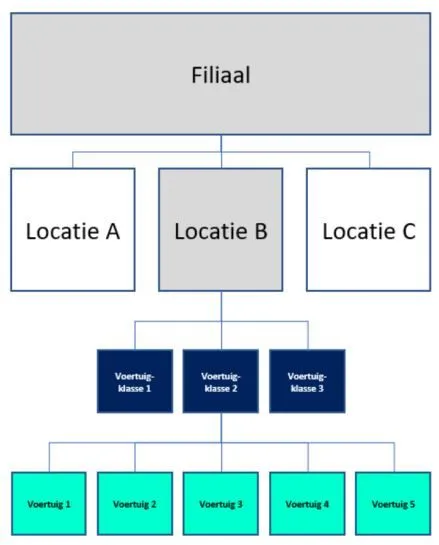
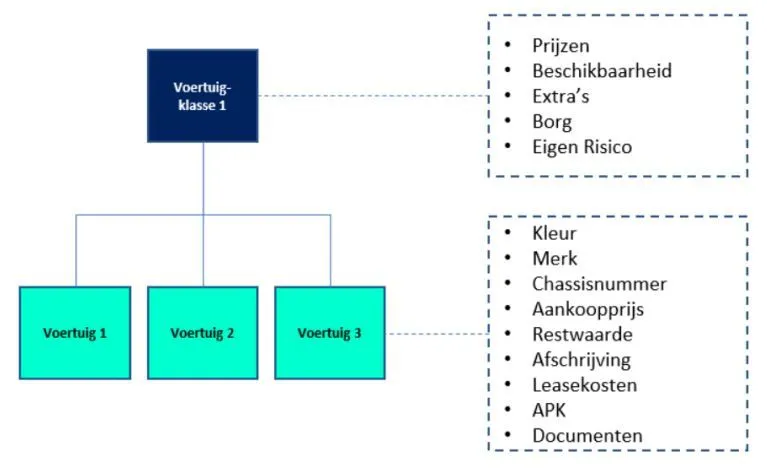
You are probably thinking: that's nice, but what do I do with it? Good, let's go one step deeper. You can think of the vehicle class as the 'vehicle' you present to the outside world, for example on your website. The vehicle class determines the price, the extras (upsells), the size of the deposit, the excess and the availability. The vehicle itself is mainly of internal importance. Every vehicle has unique characteristics. Not only can the colour and make differ, but so can the purchase price, residual value, depreciation, lease costs, MOT inspections and vehicle documents.
Example 1 – Short-term rental
In short-term rental it is common to place several types of vehicle in a single class. A Mercedes Vito and a Citroen Jumpy, for example, can both be rented out as a 6m³ van. The price for both types of vehicle is identical. The deposit, the available extras and the excess are also the same for both vehicles.
Another example, for passenger cars, is the 'budget class'. This includes the Toyota Aygo as well as the Volkswagen Up.
Example 2 – (Short) lease
In (short) lease the type of vehicle matters more. In that case it is also advisable to create a separate vehicle class for each type of vehicle. Instead of the vehicle class 6m³ van, you then get the vehicle class Mercedes Vito and the vehicle class Citroen Jumpy. For passenger cars you get both a Toyota Aygo class and a Volkswagen Up class.
Configuring vehicle classes
Now that the difference between vehicles and vehicle classes is clear, let's look at the minimum you need to be able to fill in at vehicle class level.
General
In terms of general details, you should at least be able to fill in the following properties:
- Description
- Class code
- Status
- Branch
- Category
- Photos
- Name for website
- Short description for website
- Long description for website
Prices
You enter the prices at vehicle class level. This is also where you determine whether the vehicle class has a per-24-hour price or whether the price should be calculated per calendar day.
Depending on the pricing method (24 hours / calendar day), you need to be able to distinguish prices for a given period per vehicle class. Think of a price per half day, per day, working week, weekend, a full week and a month.
It is essential that prices are easy to adjust. In our rental software we have chosen to display all prices in a price matrix. Here you can indicate per season which price applies.
We would like to pause briefly on the configuration of a half-day price. Many car rental companies with vans use a half-day rate, but only on weekdays. On top of that, the half-day rate only applies between, for example, 08:00 and 12:00, 12:00 and 16:00 and after 16:00. To avoid manual adjustments, and for the connection with your website, it is important that this is properly programmed in your rental software.
For completeness, we note that we leave dynamic pricing out of this part of the Ultimate Guide. The only thing we will say about it now is that future-proof rental software has taken dynamic pricing into account when the software was built. The workarounds that some parties apply are, in our view, not workable or scalable.
Extras
From a study of all rental software on the market, extras are generally the least well handled. In many rental systems extras cannot differ per vehicle class. The result: you can rent out a moving package with a passenger car, child seats are available for refrigerated vans and a minibus can be fitted with a tow hitch.
The above is especially a problem if you connect the rental software to your website. The website developers then have to do a lot of work to hide certain extras. If you subsequently change the extras, the website developers have to get to work again. This results in considerable costs.
If you do not connect the rental software, the problem is smaller but still undesirable.
Deposit & excess
Many car rental companies choose to make the deposit and the excess depend on the vehicle class. For this reason it also makes sense that you can set the deposit per vehicle class.
Availability (in depth)
The starting point is that as many reservations can be made on a vehicle class as there are vehicles. In other words: if you have five vehicles in vehicle class B, vehicle class B can be reserved five times.
However, it may be that you have more vehicles being delivered in a few months' time. You will be able to rent out these vehicles in a few months too, and ideally customers will already have reserved them. To achieve this, in most systems you have to add the vehicles manually and then set them to inactive until the delivery date.
Although this works, it is enormously time-consuming. In practice it is therefore rarely done, and revenue is lost as a result. A good rental package handles this more cleverly and in a relatively simple way: by allowing you to override the availability of vehicle classes. This lets you respond to a flexible fleet (scaling up and scaling down).
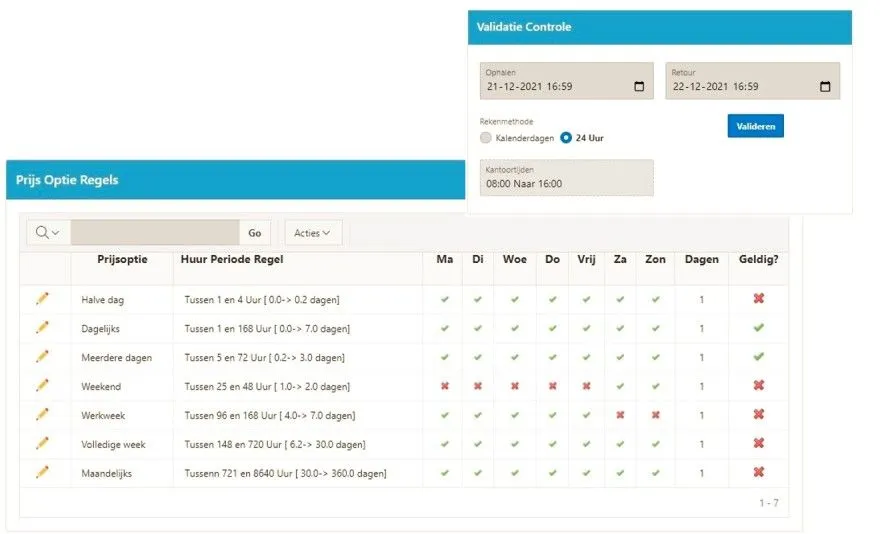
Good pricing is the foundation of well-functioning software. With our tool above, we can test whether the price options are applied at the right moments.
Configuring vehicles
Although the vehicle class is the most important for revenue and the day-to-day business, the configuration of vehicles is at least as important. The key aspect here is the cost of the vehicles.
General
Before we dive into the advanced configuration, let's briefly look at the details you need to be able to fill in per vehicle.
- Type
- Make
- Model
- Year of manufacture
- Registration number
- Chassis number
- Colour
- Engine number
- Check-out and check-in inspection list
- Defect template
- Fuel type
- Current location.
Link to vehicle classes
As we described above, a vehicle needs to be linked to one (or more) vehicle class(es). You need to be able to set this per vehicle.
Mileage and fuel tank
A vehicle has a mileage and a quantity of fuel. You therefore need to be able to fill these in. In principle this is a one-off, since these properties will change with every rental.
Damage & maintenance
Rental inevitably comes with damage. It is important that you can record this damage and add photos to it. Just as important is that a log is kept of all recorded damage, and also of which damage has been repaired. The same applies to maintenance of the car.
Tip: check whether damage to the car is recorded in walk-around order. When recording damage you walk around the car. It therefore makes sense that the damage can be recorded in the same order.
Recording costs (advanced)
The components above are of great importance for day-to-day rental. At the same time, we take the view that one component may be even more important: recording costs.
By this we mean, for example, the monthly depreciation, road tax, maintenance costs and damage and fuel that are not passed on. Recording these costs per vehicle is essential in order to ultimately calculate the return per vehicle. Many rental packages pay insufficient attention to this. Incidentally, it is of course also important that these costs are then forwarded to the accounts (for example through a real-time connection with accounting software).
Ownership (advanced)
It is of course not necessarily the case that a vehicle in your fleet is actually your property. For each vehicle you therefore want to record whether it is owned or hired in. In the case of hiring in, the logical follow-up question is: who is the owner (who am I hiring from)?
If you record this, you can immediately take it a step further. Currently, hiring in often involves a reduced rental rate for the hire-in period. However, you can also build commission models on this. In that case the owner receives a certain percentage of the revenue you generate with their vehicle. As a rental company, you can thus shift the risk of rental to the owner.
Other
Finally, it is useful to store documents per vehicle (e.g. green card) and to set reminders for, for example, the MOT and other recurring matters.
Conclusion
In this part of the Ultimate Guide to good car rental software today we have looked at the configuration of vehicles and vehicle classes. We hope this gives you a good guideline in your search for new, future-proof car rental software.
_Disclaimer: the properties mentioned in this article are a good basis for vehicle classes and vehicles. However, for a complete administration we recommend recording even more. We would be happy to explain this in a personal conversation. _
Want to talk about what we can do for you? Get in touch with the author via the link below.
Book an appointment