
Many regional rental companies earn a large share of their revenue from renting out so-called grijze kentekens (Dutch commercial-vehicle registrations). These include vans, lorries and refrigerated vehicles, among others.
However, if you drive past a few car parks of these regional rental companies today (2025), you'll generally see a lot of ‘grijs kenteken vehicles’ sitting idle.
Why is that? Is there cause for concern for car rental companies?
That's what we look at in this blog.
Abolition of the BPM exemption for grijze kentekens and zero-emission zones
The idle grijze kentekens can be traced back to two recent events. On the one hand, the abolition of the BPM exemption on grijze kentekens as of 1 January 2025. On the other hand, the changed regulations on zero-emission zones.
Abolition of the BPM exemption as of 1 January 2025
What is the BPM exemption
The BPM exemption (BPM being the Dutch tax on passenger cars and motorcycles) is a scheme that gives business owners in the Netherlands the opportunity to save tax when purchasing vehicles used for business purposes. The aim of this scheme is to encourage business owners to buy commercial vehicles without having to pay a tax rate on the vehicle's purchase price. However, this only applies to vehicles that meet specific conditions, such as the requirement that they must be used for business.
Abolition of the BPM exemption as of 1 January 2025 leads to a spike in purchases
On Budget Day (Prinsjesdag) 2022 it was announced that the BPM exemption would be abolished (ultimately taking effect on 1 January 2025). This means that from 2025 business owners have to pay BPM when purchasing a vehicle.
Logically, business owners responded by buying extra grijze kentekens in the run-up to the abolition of the BPM exemption. This is also reflected in the figures:
In the last month of 2024 the number of diesel vans sold rose to almost 33,000 units. This is nearly seven times as many as in the same period in 2023. Q1 2025: a drop of [93.2%] – The number of diesel vans registered in Q1 2025 is just 1,241 compared with 18,288 in Q1 2024.
For completeness:
- For electric ‘grijze kentekens’ the BPM exemption has not been abolished.
- There is a transitional arrangement for vehicles with a date of first registration no later than 31 December 2024.
Impact on the rental market
From what is described above, it's clear that more grijze kentekens have come onto the road. For car rental companies this leads to a drop in demand. After all – to put it bluntly – more business owners now have their own commercial vehicles, reducing the need to rent.
Changed regulations on zero-emission zones
What are the zero-emission zones
A zero-emission zone is an area without emissions of harmful substances. This means that lorries and vans in the zero-emission zones must be emission-free from 1 January 2025. Currently 16 municipalities have introduced a zero-emission zone.
Vehicles permitted under the announced policy
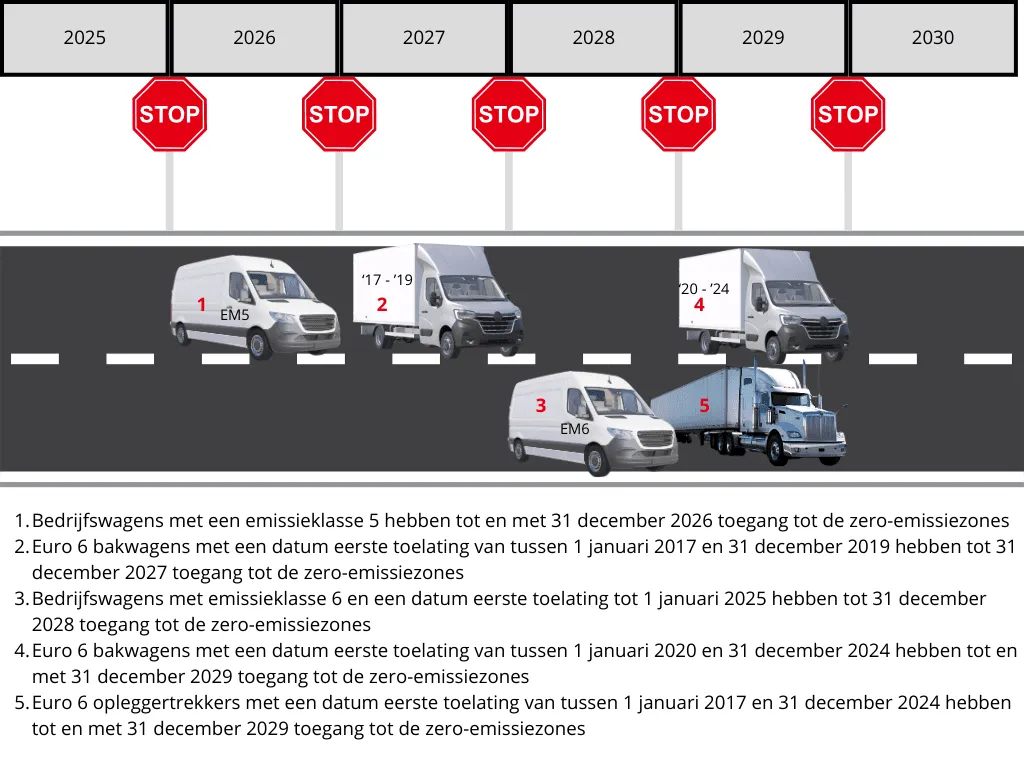
For vans, emission class 5 vehicles had access up to and including 31 December 2026. Vans with emission class 6 were given access for a year longer, namely up to and including 31 December 2027.
Vehicles permitted after the relaxation of 22 November 2024
On 22 November 2024 the cleanest diesel vehicles of emission class 6 were given another extra year. State Secretary Jansen (PVV, environment) indicated at the time that access for these vans would be extended up to and including 31 December 2028.
Impact on the rental market
For rental companies, the emergence of the zero-emission zones looked like an opportunity. After all, business owners were being forced to renew their fleets, which is not feasible or commercially sound for every company.
Rental companies responded by renewing their fleets. Reinforced by the abolition of the BPM exemption. Because of the later relaxation of the regulations, the expected increase in demand has failed to materialise.
Conclusion: the abolition of the BPM exemption and the relaxation of zero-emission zone rules prove a toxic cocktail for the rental market
For regional car rental companies that earn a large share of their revenue from renting out grijze kentekens, hard times appear to have arrived. Because of the abolition of the BPM exemption, there is less demand for renting grijze kentekens. On the other hand, the relaxed regulations on zero-emission zones have meant that demand for rental vehicles is not increasing as expected.
What does this mean for rental organisations? How can they absorb this? Will it lead to a wave of bankruptcies?
We'll come back to questions like these next week.
Curious how we can help you manage your fleet? Get in touch with us.
Book an introductory call.