
In part 8 we looked at the role of car rental software in analysing (financial) data and the importance of good reporting. We noted that it is then up to you to do something with the data and information. Analyse, formulate a hypothesis, experiment and repeat.
In this part we zoom in on external points of attention and the possibilities that good rental software offers. We cover the technical aspects and focus on the connection with your website by means of an API.
API
What is an API
An API (Application Programming Interface) is a software link that allows two software applications to talk to each other and work together. It is, as it were, the connection between two applications.
In our blog on APIs and Rental Software we compare an API to a waiter in a restaurant. The waiter is the link between the customer and the kitchen. The waiter takes the order from the customer and passes it on to the kitchen. When the food is ready, the waiter collects the dish from the kitchen and brings it to the customer.
Why an API?
It is actually very simple: without an API, software systems do not talk to each other. In other words, as a software supplier you have to build every software solution yourself if you do not use APIs. We absolutely recommend this for the core of the software product, but not for every possible add-on solution.
In a world where software solutions follow one another at a rapid pace, it is wise to focus on core matters. Other solutions that enrich your core product are usually made available by another party.
You can add these other solutions to your core product via an API as well, without carrying the burden of developing them.
This is also the starting point of the RentVisie car rental software and the underlying FrameWork. We only develop the software that touches the core of our solutions and is not yet available in the market. Other solutions we integrate into our rental software FrameWork by means of an API.
Examples of common API integrations in car rental software
Now that you understand why it is useful and wise not to want to develop everything yourself, let us briefly look at the most common API integrations in Dutch car rental software:
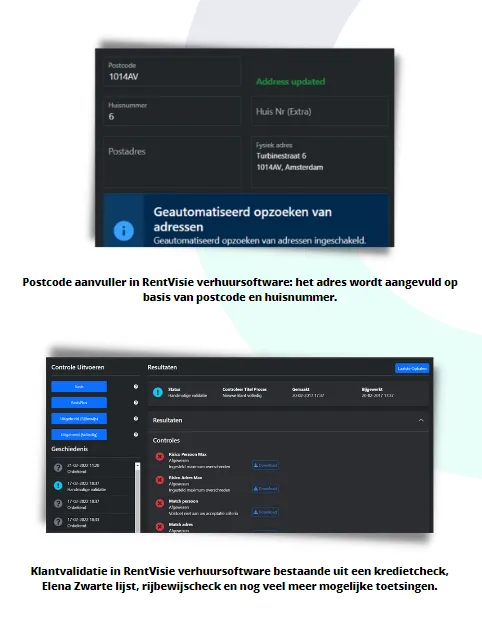
- ELENA / blacklist check
- Postcode lookup
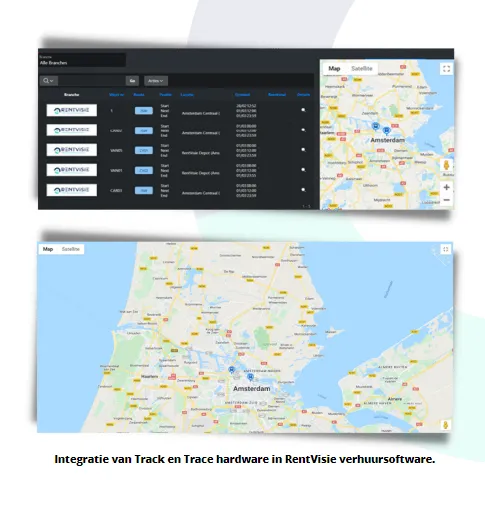
- Track & Trace integration
- Driving licence validation
- CJIB (fines)
- ROB-BOL
- Accounting (Exact)
API for website and app integrations
Besides integrating other software solutions into the car rental software, it is also important that the car rental software has a well-built and well-documented API.
This matters, among other things, for connecting the car rental software to the rental organisation's website. We recommend that everyone does this, for a variety of reasons. We will mention a few.
First, you can pass reservations from your website straight through to your rental software. This means you no longer have to copy and paste customer details, and the customer is automatically kept informed of the status of their reservation from the rental software.
In addition, you can display the fleet and prices registered in the car rental software on the website. This means you do not have to create vehicles and vehicle classes twice (read: in the software and in your Content Management System).
You can also make your reservation module real-time. That means the customer can only reserve up to a maximum number per vehicle class. This saves you spending a lot of time on reservations for which you have no availability and no suitable alternative.
That last point (a suitable alternative) can also be solved on the website by working with so-called 'pool vehicles' in the car rental software.
Finally, with a good API you can build a mobile app for your customers. Think of a mobile app for making reservations, but also a mobile app combined with self-service check-in. We offer both apps from RentVisie, and a white-label version is also available.
XML or JSON (Technical)
For those interested: an API has no fixed format. The most widely used API form today is REST (Representational State Transfer) with JSON (JavaScript Object Notation). Compared with the previously common XML, JSON has the advantage that it is i) more readable, ii) faster and iii) a natural extension of JavaScript.
Cloud Hosting
Another technical aspect of car rental software concerns hosting. The main options here are: i) On-Premise (traditional), or ii) in the Cloud (Next Generation).
With Cloud hosting, applications use the Cloud network, a network of servers, instead of a connection to the server located on site (on-premise).
Advantages of Cloud Hosting
Cloud hosting offers numerous advantages over the traditional on-premise concept. First, it is more flexible, because you can easily scale up bandwidth during peak hours (on Saturday morning, for example). You only pay for the bandwidth that is used. Nor do you have the investment of an on-premise server. It is also more reliable. After all, the software is hosted on a network of servers rather than the server on site. If one of the Cloud servers fails, there is always another server that can take over the work. It is also easier to roll out updates, because as a software supplier you always have access to the Cloud. Updates therefore no longer need to be carried out locally. Finally, it is more secure, provided a good Cloud provider such as Oracle or Microsoft is used.
Bonus: Cloud providers often offer tools to manage and further develop the Cloud environment. This means you spend less time programming non-core functionality.
"Software developer eZuce sped up deployment by 98 percent and reduced costs by 20 percent when it switched to a high-performing cloud hosting platform."
Closing
In conclusion, we can say that good car rental software today has an architecture on which integrations with third parties are built (Track & Trace, Accounting, Blacklist). In addition, there should also be an (open) API through which data from the rental software can be made available externally.
The above is most easily achieved by using Cloud Hosting. That comes with even more advantages, such as i) flexibility, ii) pay-as-you-go and iii) reliability.
Want to know more about this article? Get in touch with the author via the link below.
Book a Meeting