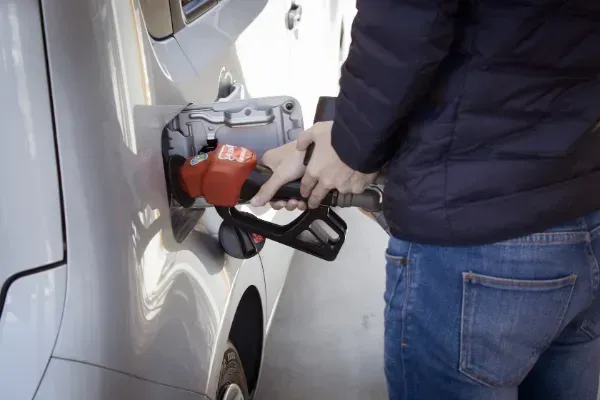
In recent months the diesel price has risen by no less than 40 cents per litre. Filling up hurts more and more. Car rental companies with several branches feel this even more.
Rising costs in car rental
In an earlier article we already wrote that rental prices in car rental are going to rise. This is mainly due to rising general costs and higher depreciation (read: more expensive vehicle purchase prices).
Transport costs are not directly included in that. However, the price of a litre of diesel at the pump has risen enormously. The recommended price of a litre of diesel now stands at almost 2.10 euros, whereas three months ago the recommended price was around 1.66 euros. In other words, diesel has become more than 40 cents per litre more expensive.
Car rental companies are not happy about it.
Vehicles on transport
Car rental companies earn a large part of their income from business customers. Since these customers generally rent the vehicles for a longer period, car rental companies offer extra service by delivering the vehicles. In industry jargon: 'on transport'.
Often the vehicles are put on a trailer and then driven to the customer by road. These trailers run on diesel. A higher diesel price therefore means a higher cost item.
In practice these costs are often barely, if at all, passed on to the renter. In fact, it is still quite common in the industry for no transport costs to be charged at all.
Transport between branches
Car rental companies with several branches suffer even more. 90% of the market currently operates on the 'shared fleet principle'. This means that the availability of the fleet is shared across all branches.
It regularly happens that a budget car is rented for tomorrow at location A, while it is currently at location B.
No problem, just a quick transport.
When you consider that the margin on a budget car is very limited, the 25% higher cost of diesel takes quite a bite.
That is compounded by the fact that in many cases a transport is not even necessary. The moment the car is being moved to the other location, a new booking comes in at location B.
Unfortunately, the vehicle has just left for location A....
Action required? RentVisie's advice
We notice that car rental companies often find it difficult to pass rising prices on to customers. We understand that, but it is necessary nonetheless.
First of all, we recommend that all car rental companies pass transport costs on (at least partly) to their customers. It is not only diesel costs that are rising; labour costs have risen considerably too. Business customers in particular will acknowledge this, so most customers will understand paying more for this extra service.
Of course, it is important to communicate this clearly to your customers in advance, so they are not faced with surprises.
Secondly, we recommend reconsidering the shared fleet method. Even before the diesel price rose, we advised many car rental companies to move away from their shared fleet method in favour of a fixed fleet. In this model, each branch has its own fleet. This makes planning simpler (read: takes less time) and means you have to carry out fewer transports (less time and money).
Naturally there is a downside. The number of rental transactions decreases, because you have to say no more often. And that while the vehicle is available at another branch.
You can mitigate that downside by working with dynamic pricing.
As an alternative to the fixed fleet or shared fleet model, you can consider a hybrid variant in which you handle transports between branches in an optimised way. The starting point here is shared fleet.
Want to know more? Get in touch with us.
More information about the hybrid fleet model?
Get in touch with us