RentVisie came about when Jeroen thought he had booked a vehicle online, only to find out afterwards that the vehicle hadn't been reserved for him at all.
It turned out the online booking was a 'reservation request'. Very common in car rental, but a rather odd principle these days. After all, as a renter you expect the vehicles offered online to actually be available to you when you book them.
Yet practice doesn't always follow suit. Perhaps rightly so?
This blog is part of a two-part series. In this blog we set out the pros and cons of real-time rental. In our next blog we look at how you can organise your processes optimally by combining the best of both systems.
1. What is real-time car rental?
Before we discuss the pros and cons, let's explain what we mean by real-time rental.
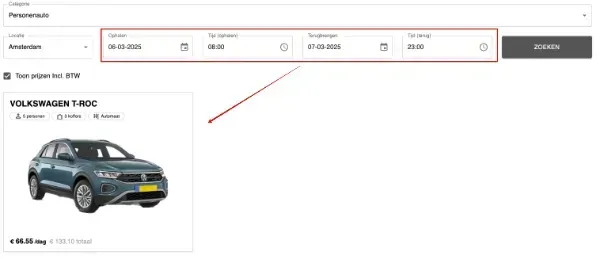
By real-time rental we mean that the end renter sees an overview of the rental offering that is matched to the availability of the rental company's fleet. The starting point is: the online offering the renter sees is available to rent. This requires a link between website and rental software. This can be done with an iFrame or an API integration, for example.
An example of an iFrame (included in the RentVisie rental software) is shown in the image below. Although the fleet is considerably larger, only the available vehicles are shown to the renter.
2. The pros and cons of real-time rental
The biggest advantage of real-time rental is that everything is connected. Reservations made via the website land directly in the rental software. Reservation confirmations are also sent automatically and immediately, which in turn reduces the number of no-shows (more on this in this blog).
Another big advantage has to do with dynamic pricing: automatically adjusting the rental price based on supply and demand. Recent research by BOVAG (the Dutch motor trade association) shows that rental companies can earn around 6% more by applying dynamic pricing. You can only do this efficiently if you rent in real time.
The biggest drawback lies in the flexibility to manage overbookings. Many rental companies rent from each other or bring in a more expensive vehicle class (free upgrade). With real-time rental you run the risk of missing out on certain reservations. We would add a caveat here, though. By using real-time rental smartly with your rental software, you can still play this game while renting in real time. We explain how this works in a next blog.
Another frequently heard argument against real-time rental is the ability to keep out 'bad renters'. Many rental companies have a manual KYC (know your customer) process before the reservation is confirmed. Here too, KYC screening doesn't necessarily have to suffer under real-time rental. We'll cover this topic in a next blog as well.
✅ Advantages:
- No waiting times: customers reserve (and possibly pay straight away too).
- No double bookings.
- Dynamic pricing
- Automatic processing of reservations, saving time and errors.
- Comes across as professional.
- Scalable.
❌ Disadvantages:
- Less flexibility to do your own planning
- Less flexibility for price agreements or special requests.
- No manual KYC screening
3. The pros and cons of reservation requests
Every disadvantage has its advantage (J. Cruijff). All the (potential) disadvantages of real-time rental mentioned above disappear when you work with reservation requests.
That, of course, comes with its own drawbacks.
The biggest drawback is the amount of work that comes with reservation requests. Imagine having to retype every reservation into your rental software. That is an enormously time-consuming process. With staff shortages and rising wage costs, you have to ask yourself whether you want to use staff for this kind of chore.
On top of that, mistakes are easily made. Sometimes you overlook a request or enter a request into the system twice.
✅ Advantages:
- More control over special requests and discounts.
- More manual control over planning
- Manual KYC screening.
❌ Disadvantages:
- Higher chance of no-shows.
- Less professional towards renters
- More work and time for staff.
- Higher chance of manual errors.
- Less scalable
4. Conclusion
Both methods have pros and cons.
Real-time rental ensures reservations are processed professionally. It saves wage costs, time and errors, reduces the number of no-shows and, above all, is scalable.
Against that, you have less room to manage the planning yourself. That potentially leads to less revenue. On the other hand, you have more control over which customers rent from you and, if necessary, you can still persuade customers to come at a different time.
All in all, there's something to be said for both.
But why choose, when you can have the best of both.
In our next blog we explain how.
🔎 Can't wait and want to know today how to get the best of both worlds? Get in touch with us and discover the possibilities!
Want to know today how to get the best of both worlds? Get in touch with us and discover the possibilities!
Book a call now!