"Dynamic Pricing? My customers absolutely do not want that!"
That was the reaction when we first introduced the concept of Dynamic Pricing to the rental industry. A logical reaction in itself, since a new concept is almost always met with scepticism.
However, Dynamic Pricing is by no means new. The concept has been applied for years by the airline industry, but also by taxis, hotels and the travel industry. On top of that, increasing digitalisation makes everything ever more measurable (data-driven), which means the concept of dynamic pricing is being applied more often and more effectively.
What is Dynamic Pricing?
Dynamic Pricing means selling the same product at different prices based on the dynamics of the market. That is why it is also known as real-time pricing, surge pricing or time-based pricing.
The idea behind Dynamic Pricing is relatively simple. The price of a product or service depends on supply and demand. Put simply, if demand rises and supply stays the same, people are willing to pay more. You can calculate the optimal price to maximise your revenue. How to do that is explained, among other places, in this article by omnicalculator.
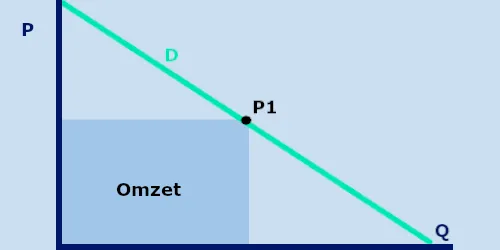
So far so good, but let's look at what happens when you can charge different prices (read: price dynamically).
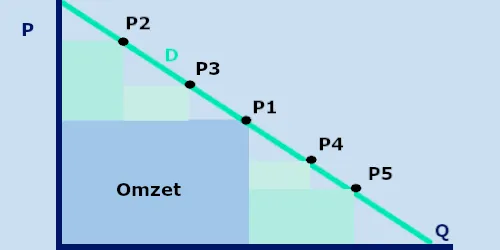
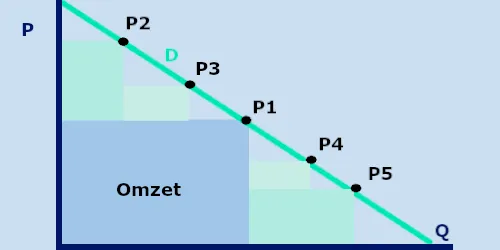
Because the price is adjusted at different moments, it is possible to generate extra revenue. This can be done, for example, by raising prices during peak hours and lowering them during off-peak hours.
Six types of Dynamic Pricing
Segmented Pricing
Segmented Pricing means offering an identical or similar product at different prices.
A company that makes good use of Segmented Pricing is Uber. The customer who simply wants to get from A to B can book a (standard) taxi ride with Uber. If you want a slightly more luxurious car, however, you can book an Uber Black at a higher rate. Although the basis of the product is identical – a car with a driver that takes you from A to B – there are certain people who are willing to pay extra for a little more service and quality.
The same thing happens in the car rental industry. Avis and Budget are part of the same company, but each brand comes with a different price and a different ideal customer. The same applies to Hertz, Dollar and Thrifty.
Time-based Pricing
Time-based Pricing is a pricing strategy that is tuned to a particular time or period. This concept is especially popular for products or services whose demand changes during a particular period.
Examples
- Holidays in high season are more expensive than in low season.
- A taxi at night is often more expensive than a taxi during the day.
- Car rental companies raise their prices at the weekend, since there is more demand then.
- After the winter sports season, the unsold skis go on sale.
Peak Pricing
Peak Pricing closely resembles Time-based Pricing, with the big difference that it concerns a price increase during busy periods. With Peak Pricing, prices are raised significantly when there is high demand at a particular moment.
Think of a holiday period, for example. The average holiday during the summer holidays is considerably more expensive than a week before or after.
Utilization Pricing
Utilization Pricing is a pricing strategy in which the price depends on the availability of the products/service. This requires that a limited quantity of goods/services is available at a particular time (aeroplanes, hotels, rentals, buses).
We also come across this concept in the airline industry. The price goes up as more tickets are sold. The last plane ticket is more expensive than the first plane ticket.
Incidentally, Utilization Pricing is not often mentioned in the same breath as dynamic pricing. In my view this is because Utilization Pricing is in fact an elaboration or automation of the other types of Dynamic Pricing mentioned above.
Penetration Pricing
During the rise of meal and rapid grocery delivery services we all became acquainted with Penetration Pricing: a company enters the market with very sharp rates (lower than their competitor) or very sharp offers. Note: the current rates will not always stay that sharp.
Another good example is – once again – Uber. An Uber ride in late 2012 or early 2013 cost almost nothing. In fact, if you were early, you could rack up quite a few rides for absolutely nothing with all the 'Refer a Friend' credits.
(Market Condition Pricing)
All of the pricing strategies mentioned above depend on the market (including supply and demand). The market is constantly moving, which means you have to keep benchmarking prices again and again and then adjust them.
In certain extreme cases you may have to adjust prices abruptly. Think of the credit crisis, for example, after which demand for products dropped considerably in one go. To remain optimally profitable in times like that too, you need to be able to change your prices quickly.
Examples of Dynamic Pricing
There are countless examples of Dynamic Pricing in the market, such as:
- Different fares for plane tickets on the same flight (Utilization / Segmented pricing);
- High advertising costs on TV around Christmas (Peak Pricing);
- The low rates and discounts of rapid grocery delivery services (Penetration Pricing);
- Night rates for taxis (Time-based Pricing);
- Expensive hotel rooms in and around Zandvoort during the Formula 1 race there (Peak Pricing);
- Different prices for a seat in a football stadium (Segmented Pricing);
- 35% discount on supermarket products approaching their best-before date (Time-based
- Pricing);
- Special discount campaigns by car rental companies during the winter sports season (Time-based Pricing);
Advantages and disadvantages of Dynamic Pricing
Advantages
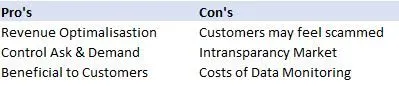
It should be clear by now that the biggest advantage of Dynamic Pricing is that revenue increases (provided, of course, that it is applied correctly). Another advantage is that you can steer supply and demand yourself, so you no longer have a surplus or shortage of products or staff during certain periods.
A frequently heard objection is that customers are not happy with Dynamic Pricing, but that is not (always) the case. In fact, during off-peak hours the customer enjoys extra discounts. The scooter rental company Felyx has been playing on this since 2020, among other things by only making downward price adjustments.
Disadvantages
The biggest disadvantage of Dynamic Pricing has to do with (extreme) upward price adjustments. Customers may feel cheated if they have to pay considerably more than normal (for example with Peak Pricing) or even more than other customers (for example with Utilization Pricing). In extreme situations this can also lead to negative publicity in the news.
For the reason above, it is important to set limits on the maximum upward price adjustment. These limits depend on the type of industry you operate in and your type of customers.
Another disadvantage is that Dynamic Pricing makes the market less transparent, which encourages customers to spend more time finding the best price (or to turn to comparison platforms).
Finally, it costs money to monitor and analyse the data and then make price adjustments.
How do I implement Dynamic Pricing in my rental business?
If you want to get started with Dynamic Pricing, we recommend reading our Whitepaper on Dynamic Pricing [coming soon]. If you really can't wait, you can already begin with the following steps:
Step 1: Define your commercial goals
Your commercial goals determine how you set up your business processes, not the other way round. A pitfall we have seen many entrepreneurs step into. Setting goals is the single most important thing for building a profitable business.
Step 2: Create a pricing strategy
Next you can get to work on drawing up a pricing strategy. This depends on your commercial goals. If you want to be known as the rental company that is reliable, it may not be wise to let prices fluctuate too much.
Step 3: Choose your pricing methods
Once you have mapped out a strategy, you need to decide which pricing methods fit that strategy. Logically, these are more specific than the general pricing strategy. Work them out and make sure you are transparent about them towards your customers.
Step 4: Set up your software
Now it is time to set up your pricing methods. Draw up pricing rules that allow your rental software to make the necessary price adjustments.
Step 5: Review and test
The most important step of all is that you assess the impact of the price adjustments and keep testing. The trick is not to draw conclusions too quickly, but to dare to intervene in time if the dynamic pricing methods are not performing the way you would like.
Want to know more? Get in touch with us.
Contact