Take Gotcha, a fictional rental company with 50 vehicles. The owner knows the website should get a new article every week. Customers search Google for a moving van, business renters compare suppliers, and a company they can't find there doesn't exist for them. But Gotcha has no marketer. The owner handles check-outs, calls customers about damage and checks the invoices at night.
He tried it once with an AI chatbot. The article was ready in ten seconds. It was also a text that could have been about any rental company in Europe: "In the dynamic world of car rental, customer satisfaction is essential." He never published it.
That is the problem this series solves. AI marketing automation does work, but not by asking a chatbot for an article. You need a harness. This is the first part of Making money with AI: what a harness is, what you need and what it earns. In the coming parts we build one step by step, and Gotcha builds along. The approach works for any rental or service business; we start with car rental because that's the business we know.
What a harness is
A harness is what a draught horse wears: the straps that make the horse's strength pull the cart in the right direction. Without a harness, a strong horse is mostly unpredictable.
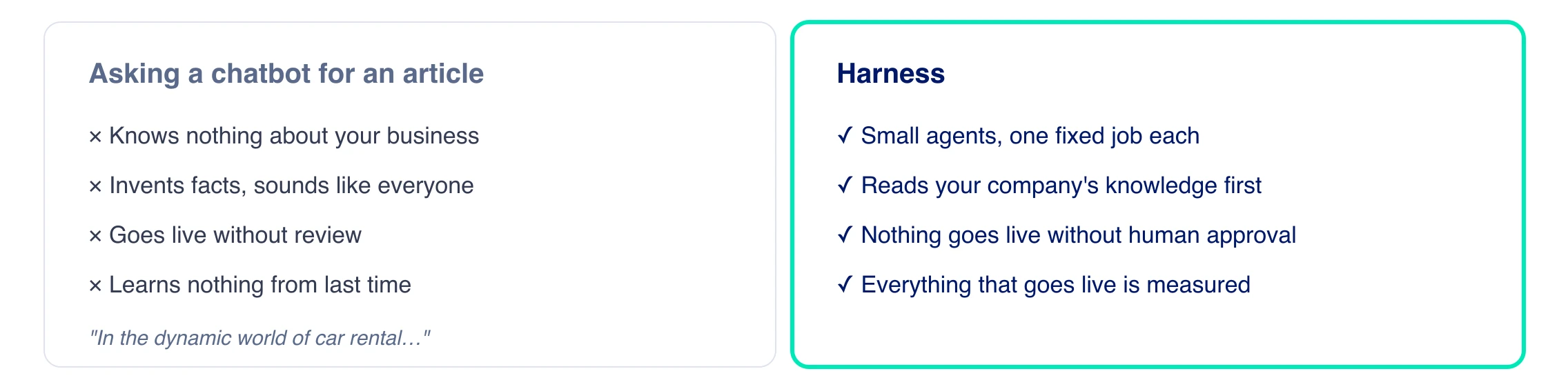
AI is the same. A language model has plenty of strength. It writes, translates and summarises faster than anyone. But without a harness it pulls in every direction: it makes up facts, sounds like everyone else and knows nothing about your company.
An AI marketing harness is that set of straps. It consists of small agents that each have one fixed job, such as writing an article every Monday or checking every week which page titles get few clicks. Every agent first reads your own company's knowledge. Nothing goes live until a person has approved it. And everything that goes live is measured.
What we built at RentVisie
We don't build for others what we don't use ourselves. So RentVisie has run a harness like this since this autumn, and this article is one of its products.
In outline, it looks like this. There is one place holding what our company knows: our facts, what we may and may not claim, our tone and the words we never use. Around it, fixed tasks run at a fixed moment each week. One writes an article in four languages with the LinkedIn posts to go with it, another proposes FAQs for a product page, a third rewrites page titles that get few clicks. Everything arrives as a draft on one overview. The owner decides there, usually in one fixed session a week. After 28 days the system checks whether a change made a difference.
What that does in practice: in the two weeks from 21 October to 3 November 2026, two articles in four languages, five FAQ extensions and ten rewritten page titles went live, each only after approval. Whether that brings visitors and conversations is something we are still measuring. That honest story follows in part 6.
We built it ourselves because no package did what we wanted: our own knowledge as the base, a person who decides, and measuring what it earns. Those three things are exactly what separates a harness from a chatbot.
Why AI marketing so often turns into slop
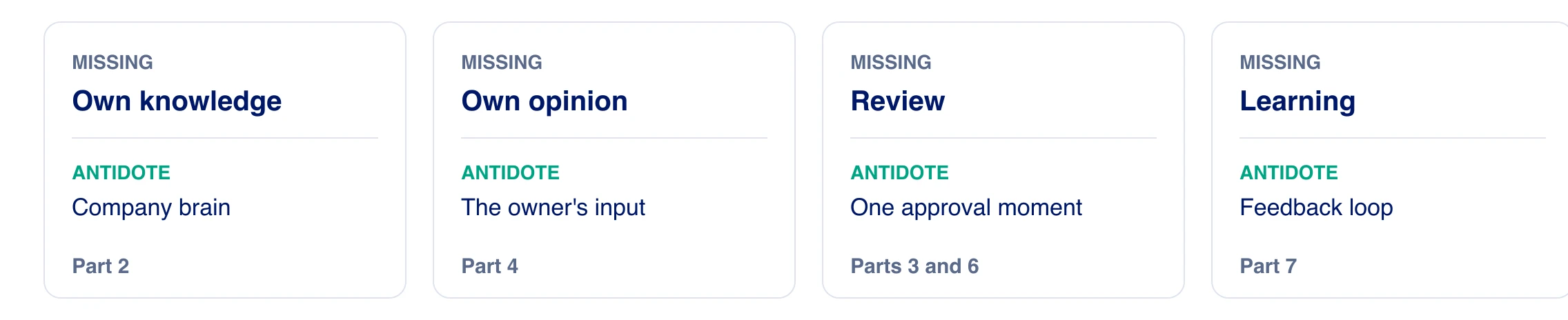
"Slop" is the word for the AI text you now see everywhere: fluent, polite and empty. It doesn't happen because AI writes badly, but because four things are missing. Each one gets its own part in this series.
- No knowledge of your own. AI doesn't know what you offer, so it fills the gaps with generalities or invents something. The antidote is a company brain, your company's fixed source of knowledge (part 2).
- No opinion of your own. An article without a position, an example or a number of your own sounds like every other article. The antidote is the owner's input as the backbone of every piece (part 4).
- No review. Text that goes live straight away also goes live straight away when it's wrong. The antidote is one fixed approval moment (part 3) and knowing what you measure (part 6).
- No learning. If nobody looks back, the same mistake gets made every week. The antidote is a feedback loop: comments and measurements go back into the harness (part 7).
What you need to automate marketing with AI
The list is shorter than most people think, and it has no expensive software on it.
- An AI subscription. A paid subscription to an AI assistant is enough to start. For reference: Claude Pro costs $20 a month when billed monthly (price on Anthropic's website, checked on 4 November 2026); other providers are in the same range.
- A place for your files. A shared folder or simple storage holding your knowledge, your drafts and your instructions.
- Access to your website. So an approved article actually goes online, published by you or by whoever runs your site.
- About two hours a week. That is the time for giving input, reading drafts and deciding. The first time takes longer, especially if your company's knowledge isn't written down anywhere yet.
- Your own knowledge. The questions customers ask, the mistakes others in your market make, the reason customers stay with you. That is the part no AI can give you.

What it earns: a marketer versus a harness
According to Searchlab, a content marketer in the Netherlands earns a median gross salary of €41,000 a year (figures from March 2026, excluding holiday pay). For an employer, holiday pay and employer's costs come on top of that.
Set a harness against it. This is a worked example: an AI subscription at $20 a month is about $240 a year. Two hours a week of the owner's time is 104 hours a year; at €60 an hour that is €6,240. Together, about €6,500 a year.

A harness doesn't replace a marketer who sets strategy, designs campaigns and talks to customers. It does the production work: writing, translating, proposing, keeping track. That is exactly the work that gets left undone in a company without a marketer. For any business that does no content marketing yet, rental company or not, it is the difference between publishing something every week and never.
And for a rental company it doesn't have to earn much to pay off. In the series More revenue from the same fleet we use €100 per rented day as a hypothetical example. One new business customer who arrives through an article and rents a van for 65 days a year brings in, in that example, as much revenue as the harness costs a year.
What you don't leave to AI
A harness does a lot, but three things stay with a person.
The approval. Nothing goes live without someone having read it. A wrong price, a promise you can't keep or a fact that isn't true costs more than a week without an article.
The opinion. AI can write your position down clearly, but it can't hold it for you. What you think about idle vehicles, about brokers or about your own industry is exactly what makes an article worth reading.
The facts. You decide once what is true about your company, and the harness uses only that. In our own system, a number without a source can't even be published until the owner has confirmed it.

The plan: what you have after each part
This series is a build project. After each part, you, and Gotcha, have one more piece in place.
- Part 1 (this article): you know what a harness is, what you need and what it should earn.
- Part 2, the company brain: one approved place for your facts, your tone and the words you never use.
- Part 3, harness v1: your first agent that does a job by itself every week, with one fixed approval moment.
- Part 4, the content generator: articles, images and video that don't sound like AI, built on your input.
- Part 5, social sharing: from one article to a week of posts, per channel and per voice.
- Part 6, measuring: what your AI marketing really earns, with a verdict after 28 days.
- Part 7, the feedback loop: how your harness gets better every week.
- Part 8, beyond marketing: the same approach in customer contact and your own processes.
Every part comes out on a Wednesday and is collected on the page of the series Making money with AI.
What you have now, and your homework for part 2
You now have the plan and the shopping list. You know why Gotcha's chatbot produced an empty text: not because AI can't write, but because nobody had told it anything about Gotcha.
That's why part 2 starts with your knowledge. The homework: write down the 20 questions customers always ask you. About the deposit, the excess, picking up on a Sunday, what happens after damage. You don't need to answer them yet. Next week we turn them into the base of your company brain.
Would you rather not build it yourself, but still have this work done every week? That is what RentVisie's digital marketing for rental companies is for.
Frequently asked questions
What is an AI marketing harness?
An AI marketing harness is a set of small AI agents that each do one fixed marketing job, such as writing a weekly article or rewriting weak page titles. Every agent works from your company's recorded knowledge, a person approves everything before it goes live, and every change is measured.
Can I fully automate marketing with AI?
Most of the production work, yes: writing, translating, proposing and keeping track. The approval, your own opinion and the decision about what is true about your company stay with a person. Leave those to AI as well and you get generic text, with the risk of mistakes going online.
What does it cost to build an AI marketing harness?
You need a paid AI subscription, a place for your files, access to your website and about two hours a week of your own time. Claude Pro, for example, costs $20 a month when billed monthly (price checked on 4 November 2026). The first time takes more time, mainly to record your company's knowledge.
Why does AI text often sound generic?
Because the AI knows nothing about your company and the text holds no position, example or number of your own. The model fills the gaps with generalities. A fixed source of your company's knowledge and the owner's input on every piece are the two main remedies.
Book a call. We show you what a harness for your rental company looks like, or we do the work for you through digital marketing.
Book a call